
Messy or overloaded cabinet
Patching is difficult to follow, switches have been added over time and nobody is quite sure what connects where.
Offices, warehouses, workshops and larger operational sites around Wigan can quickly outgrow cabling that was added piecemeal over the years. Bluebox installs and upgrades structured data and network cabling across Wigan, including Cat6, Cat6A, fibre optic links, cabinets, switching, PoE infrastructure and backbone connections between floors, areas or buildings.
Let's have a conversation →
Businesses often inherit years of additions: extra switches, unidentified cables, full cabinets, old data points and equipment connected wherever there was space. Eventually the internal network becomes the bottleneck.
Patching is difficult to follow, switches have been added over time and nobody is quite sure what connects where.
Teams rely on little desktop switches, long patch leads or temporary workarounds because the structured cabling no longer matches the office.
The broadband may be fast, but old switching, uplinks, cabling or bottlenecks inside the building can still hold users back.
Access points depend on the cabling and PoE switches beneath them. A wireless upgrade cannot fix a poor wired backbone.
Cabinet-to-cabinet or building links may need reviewing as user numbers, cloud traffic and network speeds increase.
Moves, refurbishments and new equipment often reveal that cabling was never planned for the way the business works today.
The symptom matters. A speed problem does not automatically mean the internet connection is at fault, and a strong Wi-Fi signal does not prove the network behind it is healthy.
The finished network needs to support computers, phones, Wi-Fi access points, CCTV, printers, servers and cloud-connected systems. That means thinking about data points, cabinets, switches, PoE, uplinks and future changes together.
We can add to an existing network or design a new structured installation.
We look at the cabinet and switching as well as the cable runs.
Copper and fibre can be used together where the network requires it.
We plan around the site and the equipment the business actually needs to support.
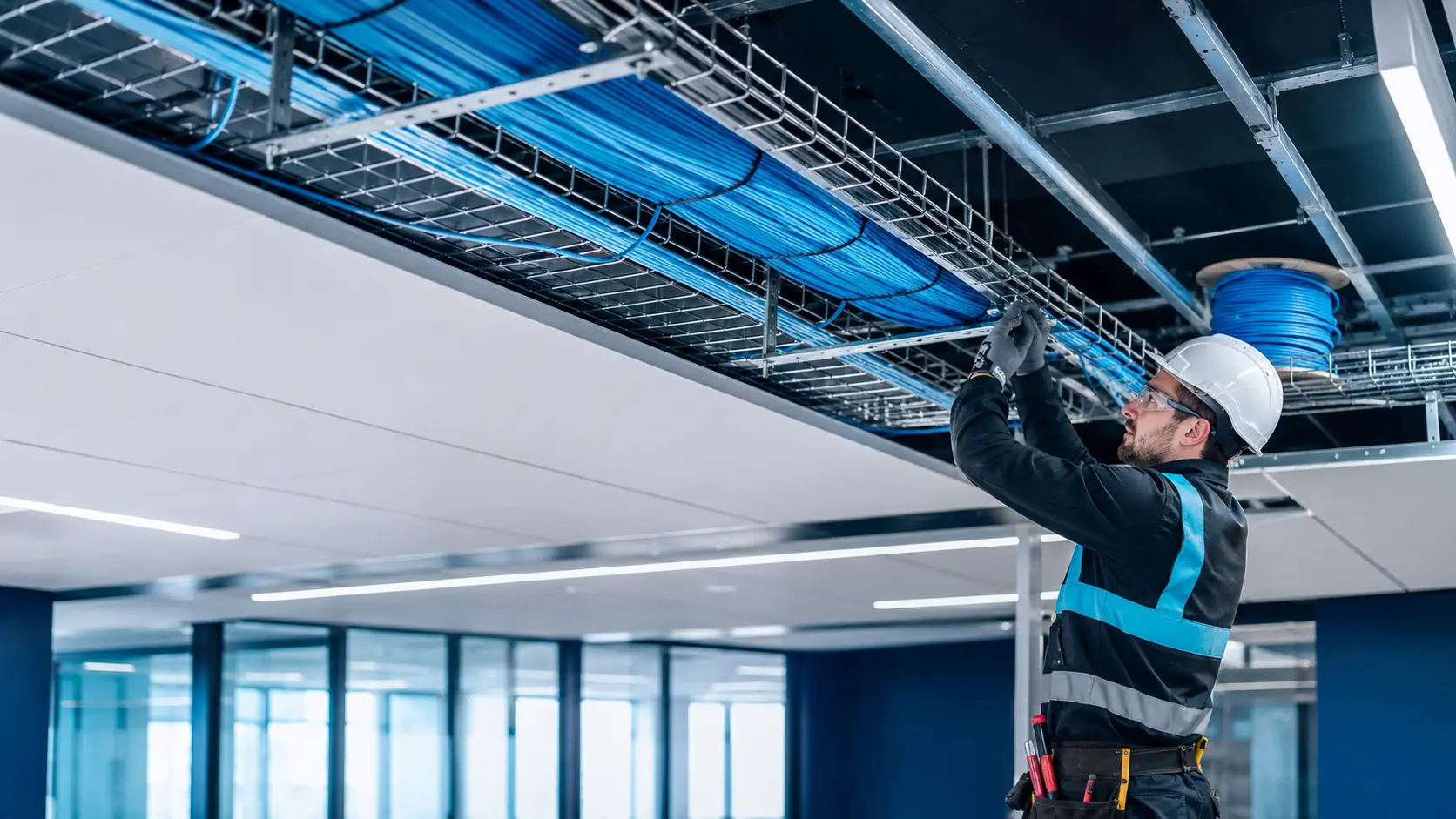
The objective is a network that is easier to support, easier to expand and capable of carrying the systems your business relies on.
Data points, patch panels and cabinets arranged so connections can be understood and maintained.
Correctly installed cabling and sensible switching reduce unnecessary weak points and workarounds.
Spare capacity and appropriate backbone links make future office changes easier to accommodate.
Wi-Fi, phones, CCTV and other IP systems can be considered as part of the same network foundation.

There is no benefit in specifying a more expensive cable simply because the number on the category is higher. Distance, network speed, environment, PoE requirements and how long the infrastructure needs to serve the business all matter.
| Infrastructure | Typical role | Why it may be chosen | What we consider |
|---|---|---|---|
| Cat6 | Office data points, phones, printers, access points and general Ethernet connectivity. | A strong commercial standard for many day-to-day business networks. | Run length, required speed, PoE load, containment and existing infrastructure. |
| Cat6A | Higher-performance copper links and projects designed around 10 Gigabit Ethernet requirements. | Greater headroom where the project specification and expected lifetime justify it. | Larger cable size, termination, bend radius, containment capacity and installation environment. |
| Fibre | Cabinet-to-cabinet, floor-to-floor or building-to-building backbone links. | High capacity, longer distances and electrical isolation between separate buildings. | Distance, fibre type, core count, optics, termination and future resilience. |
The specification should reflect the environment, distances, network speeds and expected lifetime of the installation.
Cat6 is widely used for commercial Ethernet networks and is suitable for many office and business installations. Cat6A can be appropriate where higher-performance requirements, 10 Gigabit Ethernet over full channel distances, or the project specification justify the additional size and installation requirements.
Bluebox can install new data outlets, extend existing networks or cable a complete refurbished or new workspace.
A structured installation normally brings permanent cable runs back to a communications cabinet and patch panel. This creates a clearer separation between fixed building cabling and the shorter patch leads that connect devices and switches.
Projects can include cabinets, patch panels, modules, faceplates and patching as required by the design.
Modern Wi-Fi access points, IP cameras and VoIP handsets can often receive both network connectivity and power through Ethernet using suitable PoE switching. The cable, switch capacity and device requirements all need to be considered together.
Planning this infrastructure as one project can avoid duplicated cable routes and unsuitable equipment placement later.
A network is much easier to support when the physical infrastructure is understandable. Data points and patch-panel ports should be clearly labelled, and the testing approach should match the project specification and cabling system being installed.
For larger installations, sensible documentation of cabinet layouts, backbone links and key routes can save significant time when the network is expanded or fault-finding is required later.
Network cabling is easiest to plan before desks, ceilings and finishes are complete, but existing occupied buildings can also be upgraded. Work can be phased and access coordinated to reduce disruption where practical.
For office moves, we can look at data-point locations, cabinet position, Wi-Fi access points, phones and other networked devices as one layout.
Longer distances, cabinet-to-cabinet links and connections between buildings can require fibre rather than standard copper Ethernet.
Fibre can provide a high-capacity backbone between cabinets, floors or different parts of a larger site. The appropriate fibre type, core count, termination and active equipment depend on distance, speed and resilience requirements.
Where separate buildings need to share the same network, fibre is often a strong option because it supports longer distances and provides electrical isolation between buildings. The route, containment and termination method need to be planned around the site.
Replacing cabling alone does not automatically remove every bottleneck. Switch port speeds, uplinks, SFP interfaces, PoE budgets and the way switches are connected can all affect the finished network.
Where appropriate, Bluebox can look at the switching alongside the physical cabling so the infrastructure works as a complete path.
The design has to reflect where people work, what equipment is being connected and how the building is used.
Desk positions, meeting rooms, printers, phones and ceiling access points with enough spare capacity for changes.
Longer routes, high-level access points, scanners, CCTV, office areas and robust backbone links between operational zones.
Classrooms, staff areas, Wi-Fi, VoIP, CCTV and cabinet-to-cabinet links planned around an increasingly connected site.
Fibre backbones and suitable switching can connect separate buildings without treating every area as an isolated network.
A few extra data points and a full building re-cable are very different projects. The survey needs to match the scope.
Bluebox supports Wigan businesses with network cabling, additional data points, communications cabinets, fibre links, switching and wider infrastructure upgrades. Our engineers are based in Horwich and regularly cover the wider North West.
That can include occupied offices, industrial units, warehouses, schools and multi-building sites where the cabling needs to support Wi-Fi, phones, CCTV and day-to-day business systems reliably.

First understand the problem and the building. Then decide what actually needs installing or replacing.
We look at the existing network, required data points, cable routes, cabinets and equipment that needs connecting.
We define the copper, fibre, cabinet, switching and installation work required and agree how the project will be delivered.
Cabling is installed, terminated, labelled and tested as appropriate, with the finished network ready for the connected equipment.
Bluebox works across the wider communications stack, so we can see how the physical network affects Wi-Fi, phones, CCTV, connectivity and the systems people actually use.
Cost and timescale depend on much more than the number of outlets. The building, cable routes, access, containment and existing cabinet all affect the scope.
There is no sensible flat rate for every site. The number of data points, cable type, route length, containment, cabinet work, access requirements and testing all influence the final quotation.
Often, yes. For straightforward or planned installations, drawings and point schedules can help establish an initial scope. More complex or occupied sites may still need a survey before the quotation is finalised.
Where practical, installation can be planned around access and business operations. The proposed working hours and any additional labour requirements should be agreed as part of the project.
Yes. Network cabling often forms part of a wider office move, refurbishment or IT project, so we can coordinate with the customer's IT team, electrician, builder or other contractors where required.
Cat6 is common for many commercial installations. Cat6A may be selected where the performance requirement or project specification justifies it. The right choice depends on distance, environment, equipment and future plans.
Yes. Bluebox can assess the existing cabinet and cable routes and add outlets where practical without necessarily replacing the whole installation.
Yes. Fibre can be used for cabinet-to-cabinet, floor-to-floor or building-to-building links where the distance, capacity or network design requires it.
With suitable PoE switches and compatible devices, Ethernet can carry data and power to access points, cameras, phones and other equipment. The switch PoE budget and device requirements need to be checked.
Yes. Cabinets, patch panels, modules, faceplates, patch leads and associated infrastructure can form part of a structured cabling project.
Potentially, yes. A cabinet review can identify redundant patching, unclear labelling, capacity problems or switching that has grown in an unstructured way. The scope depends on how much tracing and downtime is required.
Yes. Cabling projects can often be phased and planned around access restrictions and normal business operations to reduce disruption.
Testing should be appropriate to the installation and specification. We can define the required testing and handover approach as part of the project scope.
Yes. If switching, uplinks, PoE capacity or cabinet design are part of the problem, they should be considered alongside the physical cable runs.
Yes. The internet circuit is only one part of the path. Older switches, congested uplinks, poor cabling, network loops or badly designed Wi-Fi can make a fast connection feel slow once traffic reaches the building.
Not automatically. Existing cabling may still be perfectly serviceable for the devices and speeds it supports. We would rather identify the actual limitation than recommend a complete replacement without a reason.
Yes. Bluebox provides network cabling and infrastructure work across Wigan and surrounding areas from our North West engineering base.
If the cabling is being upgraded, it is often worth checking the broadband, Wi-Fi and phone system at the same time. These services are designed to work together.
You do not need to diagnose it first. Tell us what is slow, unreliable, messy or no longer fit for purpose and we can help work out what part of the internal network actually needs attention.
Let's have a conversation →